
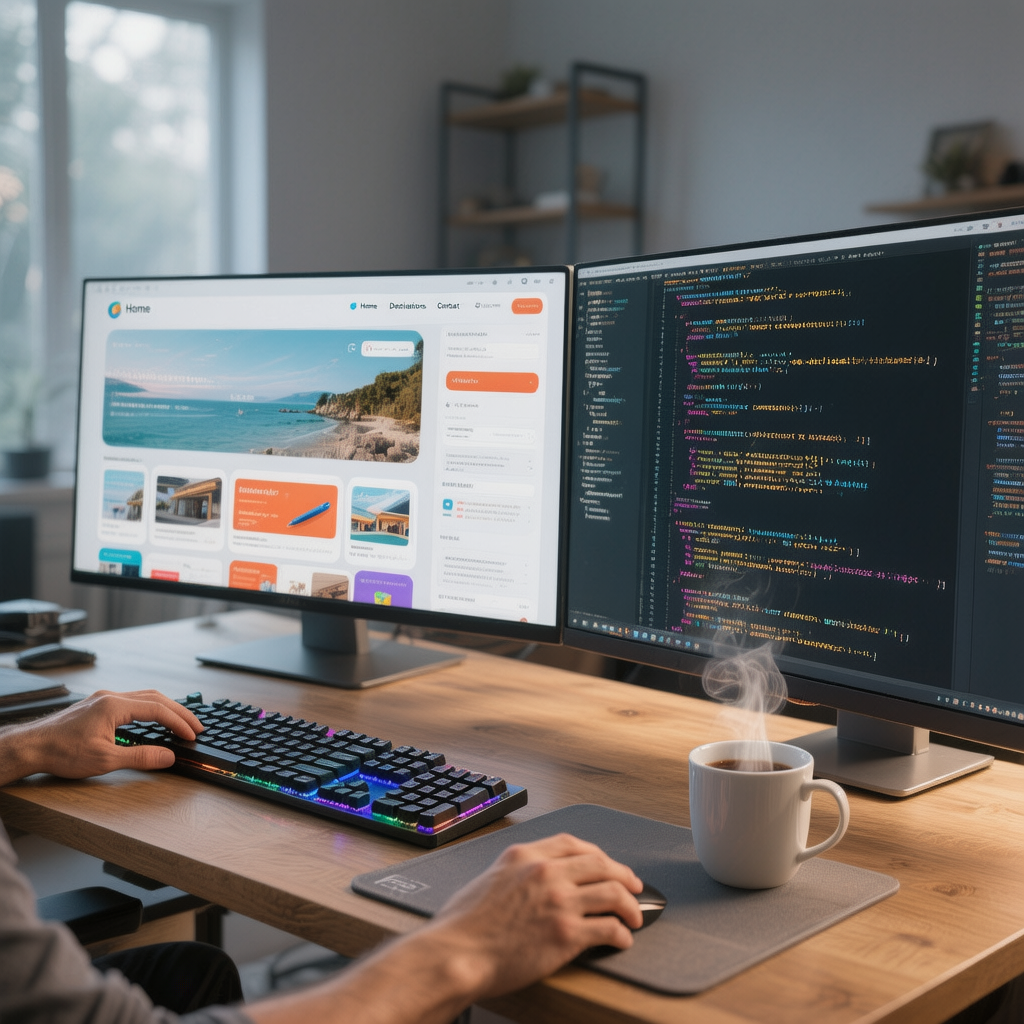
The Real Deal About Web Development in 2025: What Nobody Tells You
I’ve been building websites for years now and we can tell you one thing for sure that web development today is nothing like it was even five years ago. Everyone’s talking about AI, no-code platforms and how anyone can build a website these days. But here’s the truth – it’s both simpler and more complicated than ever. Let me break down what’s actually happening in this space right now.
The Landscape Has Shifted Dramatically
When I started, you basically had two options- hire someone expensive or learn HTML, CSS and JavaScript from scratch. Both were painful. Now? There are literally hundreds of tools, frameworks and platforms that promise to make it easy. And honestly some of them actually deliver.
But that’s also created this weird situation where everyone thinks they can be a web developer because they used a drag-and-drop builder. Don’t get me wrong – tools like Webflow, Elementor, and WordPress have democratized web development in a genuinely good way. Small businesses and entrepreneurs can actually have professional sites without dropping thousands on a developer. That’s huge.
But there’s a flip side. When something breaks, when you need custom functionality, when your site starts slowing down under real traffic – that’s where things get messy fast. I’ve seen so many businesses get burnt because they built their entire operation on a “simple” no-code platform, only to realize too late that it couldn’t scale or do what they actually needed.
What the Real Demand Actually Looks Like
Here’s something that surprises people: there’s never been more demand for skilled web developers. You’d think with all these no-code tools, we’d be obsolete by now. Instead, companies are desperately looking for people who can actually code, who understand databases and APIs and server architecture. The high-end market – the stuff that pays really well – is busier than ever.
The middle market is where things are getting squeezed though. A lot of straightforward website work – basic brochure sites, simple e-commerce setups – that’s moving to no-code platforms and freelancers using WordPress + Elementor. I’m not even mad about it. Some projects genuinely don’t need a custom built solution.
What’s happening is a polarization. You’ve got the ultra-high-end work – complex applications, specialized tools, enterprise systems – where developers command premium rates. And you’ve got the mass market of simple sites handled by no-code tools and templates. The middle ground is getting thinner every year.
The Tech Stack Wars Are Real
If you’re learning web development right now, you’ve probably already heard the arguments. React vs Vue vs Angular. Next.js vs Remix. Should you learn Python or Node.js for the backend? And don’t even get me started on the CSS debates.
Here’s my honest take: it doesn’t matter nearly as much as people pretend it does. I’ve built successful projects with boring old tech stacks and failed projects with cutting-edge frameworks. What matters is whether you understand the fundamentals – HTTP, databases, how servers work, the basics of security.
That said, React has won the frontend war. I didn’t like it for years, but you can’t ignore the momentum. If you’re starting out and you want the best job prospects, learning React is probably the smart move. For backend, Node.js and Python are both solid. Python’s easier to learn but might be overkill for web development specifically.
The real issue is that everyone’s chasing the newest, shiniest framework and it creates this treadmill where you’re constantly learning new things that might be outdated in two years. I’ve started focusing less on specific frameworks and more on understanding the underlying principles. That stuff doesn’t change.
What Actually Makes a Good Website in 2025
You know what’s wild? We’ve somehow made websites slower while computers got faster. A site that loads in under a second used to be normal. Now, if your site loads in three seconds, you’re doing pretty well. We’ve added so much JavaScript, so many third-party scripts, so much tracking, that the average website is bloated as hell.
Performance matters more than it ever has. Google cares about it. Users definitely care about it. And yet, I see way too many developers who treat performance as an afterthought. “We’ll optimize later” – yeah, you won’t.
Mobile-first design isn’t new anymore but it’s still not universal. Some businesses still treat mobile as an afterthought, and it shows. Mobile traffic makes up the majority of web traffic now. If your site doesn’t work great on phones, you’re losing customers and period.
Accessibility is another area where I see a disconnect. A lot of developers treat it like a box to tick rather than something that genuinely matters. But making your site accessible isn’t just about helping people with disabilities though that’s important. it’s about building a better site for everyone. Better keyboard navigation helps power users. Clear semantic HTML helps search engines and assistants. Good contrast helps people reading in bright sunlight.