Cloud vs Edge vs Quantum Computing: The Computing Showdown Nobody Explains Well
Your Netflix streams because servers somewhere pump data into your home. Your phone recognizes your face instantly without uploading anything. Quantum computers solve drug formulas in minutes that would take classical machines millennia.
Three different computing paradigms. Three completely different problems they solve. Three futures colliding right now.
The Cloud Computing Thing That Changed Everything
Remember when companies stored everything locally? When your office needed its own servers, backup systems, IT staff managing physical hardware? Yeah. Those days died.
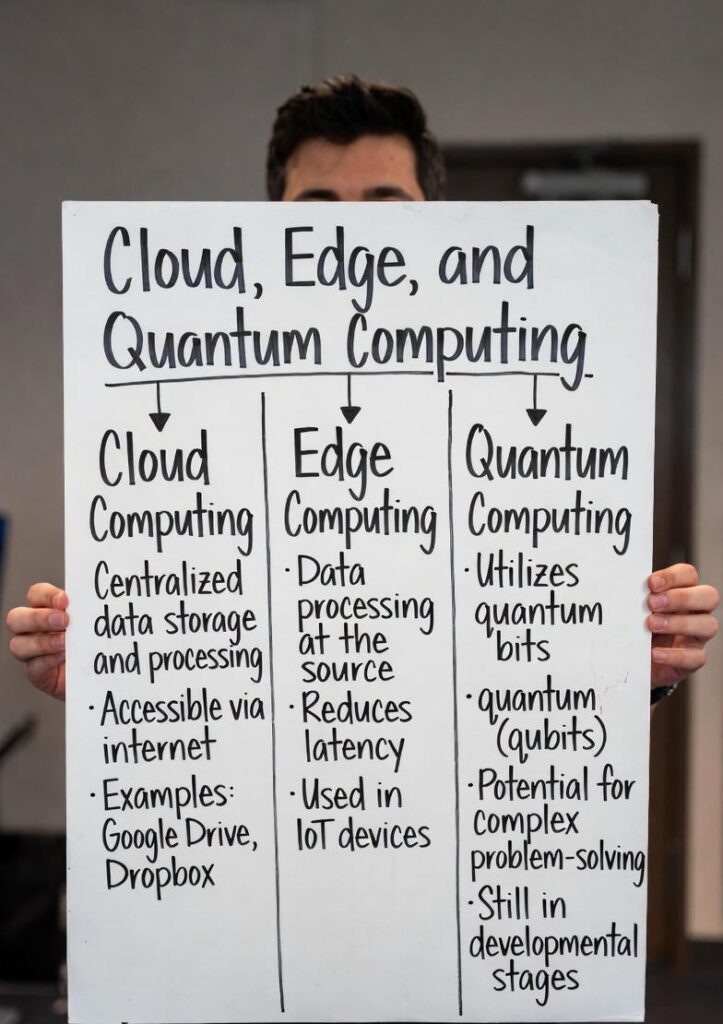
Cloud computing basically moved computation to massive data centers miles away. AWS, Azure, Google Cloud. Billions spent building warehouse-sized facilities packed with servers. You pay monthly instead of buying expensive equipment upfront.
The magic: unlimited scaling. Need more power? Click a button. Want to add storage? Done instantly. Software updates happen automatically. You focus on building products while someone else maintains hardware. It’s brilliant.
The problem though? Data travels from your phone or sensor all way to the data center potentially thousands of kilometers away. Information gets processed in distant servers. Response time crawls compared instant local reactions.
For Netflix? Totally fine. You buffering a few seconds means nothing. For a self-driving car? That delay kills people. For surgical robots? Unacceptable risk.
Edge Computing Arrives To Fix Cloud’s Latency Problem
Edge computing takes computation and shoves it right next door where data originates.
Your IoT sensor doesn’t send raw data to the cloud anymore. It processes locally. Your autonomous vehicle doesn’t wait for cloud permission before stopping. It decides instantly using onboard computers. Your security camera analyzes video right there instead of uploading everything for cloud processing.
The name comes from computing moving toward “the edge” of networks instead of staying centralized. Edge devices handle real-time decisions. Only summaries or important data travel to the cloud afterward.
Amazon uses edge servers in warehouses. Tesla deploys edge processing across autonomous vehicles. Healthcare facilities run edge systems for patient monitoring. Nobody wants waiting for cloud response times when lives depend on immediate action.
Here’s what makes edge powerful: millisecond response times without internet dependency. Process locally, stay secure, reduce bandwidth requirements dramatically. A surgical robot makes decisions based on local processing. No network lag. No cloud reliance.
The catch? Edge devices have limited power compared cloud data centers. You can’t run massive machine learning models on every edge node. Scaling gets complicated. Managing thousands of edge devices beats managing one cloud center.
Edge computing demands sophisticated engineering. You need smart devices. Reliable local processing. Fallback systems when connectivity fails. It’s harder than cloud but delivers performance cloud cannot match.
Quantum Computing Isn’t Here Yet (But It’s Coming)
Cloud and edge compute using classical bits. Zero or one. On or off. Boolean logic running everything.
Quantum computers use qubits. Simultaneously zero AND one through superposition. They calculate multiple possibilities simultaneously instead sequentially. Different animals entirely.
Here’s why people care: certain impossible problems become solvable.
Drug discovery currently takes decades and billions. Researchers test millions of molecular combinations searching for compounds that work. Quantum computers simulate molecular behavior at quantum levels. Drug candidates emerge in months instead years.
Cryptography relies on mathematical problems too hard classically. Quantum computers crack most modern encryption methods instantly. Financial institutions panic about quantum computing arriving before quantum-safe encryption deploys everywhere.
Supply chain optimization involves finding best routes among infinite possibilities. Amazon warehouses handle millions of items daily. Classical computers approximate answers. Quantum computers find actual optimal solutions.
Battery design for electric vehicles requires simulating complex material interactions. Tesla, BMW and others investigate quantum computing for developing better batteries. Longer range. Faster charging. Better safety.
Financial modeling in milliseconds. JPMorgan and other trading firms already experiment with quantum algorithms. Processing complex market scenarios that classical computers cannot handle quickly enough.
The honest truth? Quantum computing remains mostly theoretical. Google claims “quantum advantage” for specific benchmark problems. IBM, Microsoft, Rigetti and others build quantum systems. Real-world applications remain limited.
Quantum computers also need extreme conditions. Near absolute zero temperatures. Perfect isolation. Massive infrastructure. They’re finicky and unreliable compared classical systems right now.
But they’re advancing faster than most people realize. In five years? Ten years? Game changing technology emerges.
The Comparison (Because You Need Context)
Cloud computing handles massive data processing at scale. Netflix recommendations, Google searches, Instagram feeds. Excellent when latency doesn’t matter and you want infinite resources.
Edge computing handles real-time decisions locally. Autonomous vehicles, surgical robots, industrial automation. Essential when milliseconds matter and you can’t depend on network connectivity.
Quantum computing handles specific impossible problems. Drug discovery, cryptographic breaks, complex optimizations. Still experimental mostly but advancing rapidly.
They’re not competitors. They’re complementary. Future systems combine all three.
Your autonomous vehicle processes local sensor data through edge computing for instant reactions. Meanwhile it uploads anonymized patterns to cloud servers for analysis and model improvement. Sometime in future, quantum computing optimizes routing for entire city traffic simultaneously.
Where These Careers Actually Lead
Cloud engineers build infrastructure. ₹6-15 lakhs in India. $90k-$160k globally. High demand everywhere. AWS, Azure and Google Cloud certifications command premium salaries.
Edge computing specialists still emerging as distinct role but growing rapidly. ₹7-18 lakhs locally. $100k-$180k internationally. IoT companies, automotive firms, industrial automation desperately hire these folks.
Quantum engineers currently rare but increasingly sought. ₹8-20 lakhs in India. $120k-$250k+ globally if you’re genuinely skilled. IBM, Google, rigetti and startups compete aggressively for talent. PhDs get preferential treatment currently.
Solutions architects design which computing approach solves which problems. ₹12-25 lakhs locally. $150k-$300k+ internationally. Deep expertise in all three makes you extremely valuable.
Remote work opportunities explode across all three. Your location matters less than expertise. Indian engineers work for Silicon Valley companies, European banks and Australian startups without relocating.
The Uncomfortable Truths
Learning all three simultaneously guarantees overwhelm. They require different skillsets and mindsets.
Cloud demands understanding distributed systems, containerization and infrastructure-as-code. Edge requires embedded systems knowledge, real-time processing and edge AI. Quantum needs quantum physics, quantum algorithms and linear algebra at advanced levels.
Most developers pick one and go deep.
Cloud engineering feels mature but competition intensifies constantly. Everyone knows AWS basics now. Standing out requires specialization in specific services or architectures.
Edge computing lacks standardized tooling. Kubernetes helps but ecosystems remain fragmented. Integration challenges plague real-world deployments. Debugging edge problems across thousands of devices nightmare. Logging and monitoring distributed edge systems remains unsolved largely.
Quantum computing remains experimental. Investment capital keeps flowing but practical applications stay limited. Job market remains small. If you bet heavily on quantum now, you risk specializing in field that might not reach mainstream for decade or more.
Hybrid approaches complicate everything. Managing workloads across cloud and edge simultaneously requires sophisticated orchestration. Data consistency becomes harder. Security surfaces expand. Operational complexity increases.
How Actually Getting Started Works
For cloud: pick your poison. AWS dominates market share. Google Cloud attracts data scientists. Azure wins enterprise contracts. Learning one makes others obvious. Start with free tier. Build stupid projects. Deploy them. Experience AWS Lambda, RDS, S3 practically.
For edge: understand IoT fundamentals first. Learn single board computers like Raspberry Pi. Program Arduino. Build something collecting sensor data locally. Graduate toward industrial edge computing platforms. NVIDIA Jetson boards run actual AI locally. Get hands-on.
For quantum: this one’s tricky. IBM offers free quantum computer access online. Learn Qiskit (quantum SDK). Study quantum mechanics at least conceptually. Linear algebra matters. Start with tutorials understanding superposition and entanglement before touching code.
Join communities. Quantum computing subreddit helps. AWS forums answer cloud questions constantly. Edge computing groups on LinkedIn connect practitioners. Don’t learn alone.
The Mistakes People Make Consistently
Mistake one: thinking these compete directly. They don’t. Stop comparing them like you must choose one forever.
Mistake two: learning cloud then assuming edge skills transfer directly. They don’t. Real-time constraints change everything. Embedded systems thinking differs fundamentally from cloud-scale thinking.
Mistake three: chasing quantum hype without understanding fundamentals. Learn classical computing deeply first. Quantum knowledge builds atop that foundation.
Mistake four: ignoring hybrid deployments. Most real systems use multiple approaches. Your edge devices sync with cloud. Your quantum computer feeds outputs into classical processing. Integration matters.
Mistake five: neglecting security implications. Cloud security differs from edge security. Quantum computing breaks modern encryption. Future-proofing requires planning now.
Mistake six: assuming bandwidth stays unlimited. Edge computing exists partly because bandwidth constraints matter. Design accordingly.
Mistake seven: building monolithic systems instead modular ones. Make components replaceable. Swap cloud providers without rewriting everything. Build edge systems that work offline.
What Actually Matters Going Forward
Cloud computing stays dominant but edge becomes equally important increasingly. Companies stop thinking cloud-only. They think hybrid cloud-edge deployments solving different workloads optimally.
Quantum computing eventually reshapes cryptography and optimization. It won’t replace classical computers. It’ll augment them for specific hard problems.
Engineers skilled across multiple paradigms become exceptionally valuable. Generalists who understand trade-offs between approaches, who design systems picking right tool per problem, who integrate diverse technologies successfully—those people get paid generously.
Emerging roles blend all three. Platform engineers. Systems architects. Solutions designers. These positions require understanding each domain deeply enough designing integrated systems effectively.
Final Thought
These three computing paradigms represent different answers to different questions. Cloud asks “how scale massively?” Edge asks “how respond instantly?” Quantum asks “how solve impossible problems?”
You don’t need mastering all three immediately. Start somewhere. Go deep. Expand gradually. Build projects combining multiple approaches. Let curiosity guide learning.
The future doesn’t pick one winner. The future combines all three intelligently. Engineers who understand that combination become essential.
Pick your starting point and commit. Everything connects eventually.